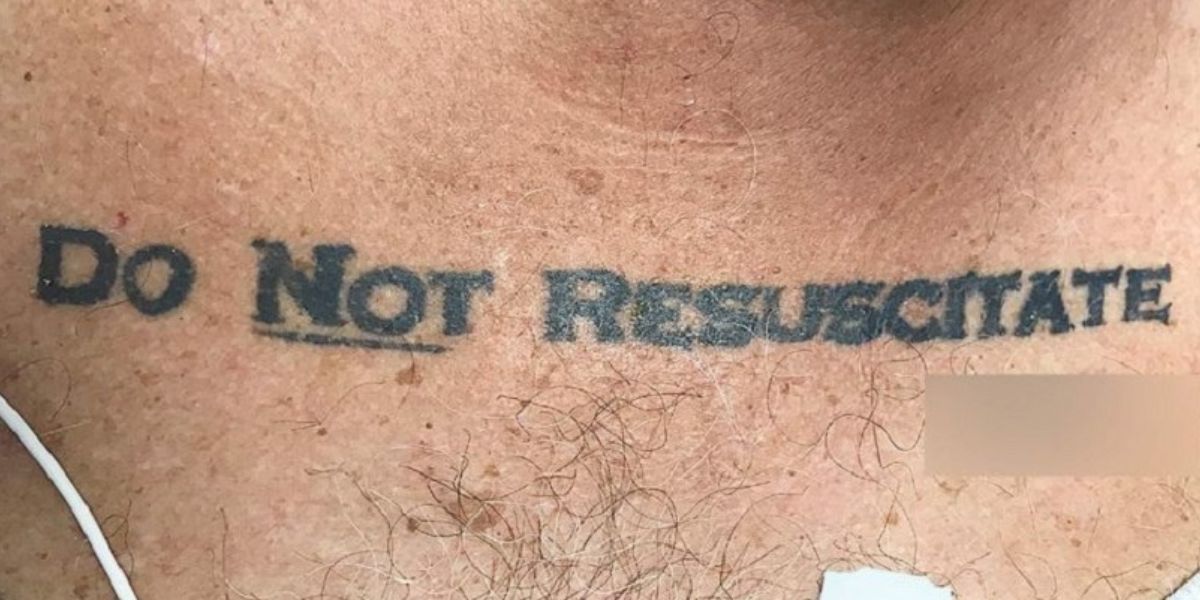
 Imagine you come across someone unconscious who needs CPR. You’re about to act, but then you notice a tattoo on their chest that reads: “DO NOT RESUSCITATE.”
Should you ignore it and start CPR anyway? Could there be legal consequences if you go against it? And how can you tell if the tattoo actually reflects the person’s wishes, or if it’s a joke?
This situation isn’t hypothetical. A team of doctors in the United States faced exactly this dilemma when a patient arrived at an emergency department with “DO NOT RESUSCITATE” tattooed across his chest. The word “Not” was underlined, and what appeared to be his signature sat beneath it.
Uncertain whether the tattoo was genuine or symbolic, the doctors began treatment while seeking advice from their hospital’s ethics team.
What did they decide?
After reviewing the situation, the ethics team recommended that the tattoo be honoured. Their reasoning was that it was reasonable to interpret the tattoo as a clear expression of the patient’s wishes.
The man later died without being resuscitated. It was subsequently confirmed that he had completed formal documentation supporting the same decision reflected in the tattoo.
This case sparked widespread discussion about whether tattoos like this should be considered valid or legally binding.
So what would happen in Australia?
The situation here is less straightforward.
Unlike some hospitals overseas, Australian hospitals do not typically have ethics teams available to review cases like this in real time. While advance care planning does exist, the legal requirements vary between states and territories.
For an advance care directive to be followed, a doctor generally needs to be confident that:
- The person had decision-making capacity at the time
- They understood the consequences of refusing treatment
- The directive applies to the current situation
In an emergency, especially for a first responder, this information is almost never available.
Can a tattoo be trusted?
A tattoo might reflect someone’s wishes, but it is not reliable evidence on its own.
People can change their minds over time. The tattoo may have been done as a joke or under the influence. Even something as simple as “DNR” could stand for something entirely different.
Without formal documentation, there is no way to verify intent in the moment.
What should first responders do?
In Australia, first aiders are trained to treat unconscious casualties under the principle of implied consent. This means care should be provided because the person cannot express their wishes.
In practical terms, that means:
- You should not rely on a tattoo when making a decision
- You should follow your training
- You should provide CPR if it is needed
When someone’s life is at risk and they cannot communicate, your responsibility is to act based on your training, not assumptions. Even in complex or unusual situations, the safest and most appropriate response is to provide CPR if it is required.