Severe bleeding first aid: What should you do?
Severe bleeding can become life-threatening quickly. If bleeding cannot be controlled by firm, direct and continuous pressure, it should be treated as a serious emergency.
When severe, life-threatening bleeding is obvious, controlling it quickly can be lifesaving. Call Triple Zero (000) early and act to control the blood loss.
How do you know if bleeding is severe?
Some situations are obviously serious. An amputation, shark attack, propeller injury or other major trauma can cause severe, life-threatening bleeding.
In other cases, look at both the bleeding and the person's condition. Signs that someone may be experiencing severe blood loss include:
- weak, rapid pulse
- obvious signs of bruising or bloating in the stomach region
- pale, cool or moist skin
- sweating
- rapid or gasping breathing
- restlessness
- nausea or thirst
- dizziness, faintness or confusion
- loss of consciousness
Remember that the significance of blood loss can also vary between people. An amount of blood loss that may be relatively minor for an adult could be very serious for a small child.
What should you do for severe bleeding?
If someone is bleeding severely, act quickly.
Follow DRSABCD and call Triple Zero (000)
- Check for danger and conduct a Primary Survey.
- Send for emergency medical assistance as early as possible.
- If severe and life-threatening bleeding is obvious, controlling the bleeding can take priority over Airway and Breathing.
Apply firm, direct and continuous pressure
- Wear disposable gloves if they're available and expose the wound so you can see where the bleeding is coming from.
- Apply firm, direct and continuous pressure to the wound. The injured person or a bystander may also be able to help maintain pressure.
- When available, place a pad or dressing in or directly over the wound and continue applying pressure until the bleeding stops.
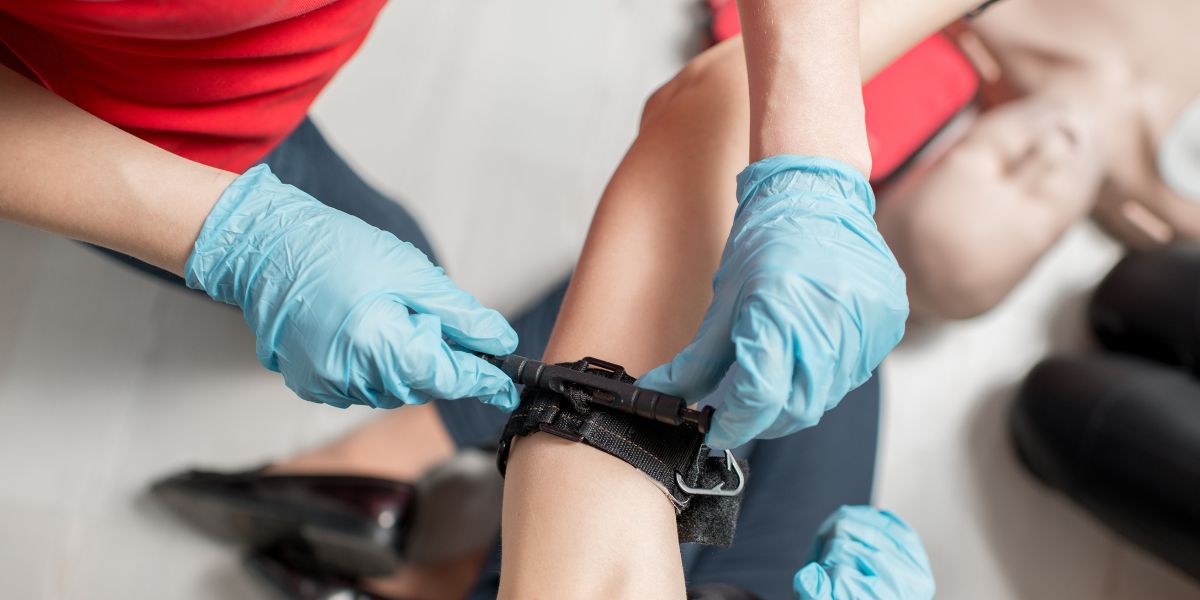
- If the bleeding doesn’t stop use a Haemostatic dressing and or a tourniquet.
- Once controlled, secure the pad firmly with a bandage.
Don't stop monitoring and treat for shock
- Keep the person still, reassure them and continue checking their consciousness, breathing and pulse.
- Watch the wound for further bleeding and give them nothing to eat or drink while waiting for emergency medical assistance.
- If blood comes through the first pad, leave it in place and apply another pad and a tighter bandage over it.
What if the bleeding won't stop?
Life-threatening bleeding that doesn't respond to direct pressure may require additional measures.
For severe bleeding from a limb, a first aider trained in its use may need to apply a commercially made windlass tourniquet. A haemostatic dressing may also be appropriate in some circumstances for a first aider trained in its use.
These are practical emergency skills where proper first aid training becomes particularly important. Knowing that a tourniquet exists isn't the same as knowing when and how to use one safely.
What if something is stuck in the wound?
Don't remove an embedded object.
Removing it could cause further damage or increase the bleeding. Instead, apply pressure around or on either side of the object and use padding around it before securing the padding with a bandage.
Severe bleeding: remember these three things
If most of this article disappears from your memory tomorrow, remember:
Get help. Apply pressure. Keep monitoring.
Severe bleeding can become life-threatening quickly, so call Triple Zero (000) early and take action to control the bleeding.
And if reading this has made you wonder whether you'd know what to do with a real person bleeding in front of you, that's precisely where practical first aid training comes in.
Learn first aid with Royal Life Saving WA
Royal Life Saving WA is a Registered Training Organisation (RTO 0854) providing nationally recognised first aid training in Perth and across Western Australia, including HLTAID011 Provide First Aid.
The HLTAID011 Provide First Aid course covers life-threatening and non-life-threatening bleeding, alongside DRSABCD, CPR and AED use and a range of other first aid emergencies.
Royal Life Saving WA's current HLTAID011 course combines approximately 3-4 hours of online learning and assessment with one day of face-to-face training and assessment, giving participants the opportunity to put first aid knowledge into practice. Courses are conducted in Perth and other locations across WA.
Explore HLTAID011 Provide First Aid courses with Royal Life Saving WA
Severe bleeding FAQs
When is bleeding considered life threatening?
Bleeding should be managed as severe and life-threatening if it cannot be controlled by firm, direct and continuous pressure and/or the person is showing signs of shock.
Should you remove an embedded object from a wound?
No. Leave an embedded object in place and apply pressure around or on either side of it rather than directly over it.
Where can I learn how to respond to severe bleeding in WA?
Royal Life Saving WA provides HLTAID011 Provide First Aid and HLTAID014 Provide Advanced First Aid training in Perth and other locations across Western Australia through RTO 0854. Life-threatening and non-life-threatening bleeding are among the topics covered in the course.